The Verdict (If You Only Read One Section)
We generated 16 videos across four budget-friendly AI video models with identical prompts, one account, and a stopwatch. Here is the short version:
- Grok Imagine 1.5 — Cheapest per clip by far (from 40 credits) and the only one that outputs 8-second clips at this price — but it is image-to-video only. No starting image, no video.
- Hailuo 02 — Best all-rounder on a budget: does both text-to-video and image-to-video, strong mood and lighting, weakest fine detail — footage comes back noticeably softer than the others.
- Kling 3.0 Turbo — The quality ceiling of this group: fastest average generation in our tests, crispest footage by bitrate, and the only model that rendered legible text. You pay roughly 7× a Grok clip for it.
- Seedance 2.0 Mini — The most cinematic color out of the box and the smoothest continuous camera moves — a filmmaker look for social clips, slightly behind Kling on raw realism.
How We Tested
Every comparison article we could find either re-publishes vendor marketing clips or "tests" one model at a time across different prompts. So we did what you would do: opened one CreateVision account and ran the exact same prompts through all four models on 2026-07-08.
- Same prompts, same settings: 720p (768p on Hailuo, which does not offer 720p), 5–6 second clips, default settings, no cherry-picking — every video below is the first and only take.
- Measured, not quoted: generation times are wall-clock seconds from task creation to downloadable file, not vendor claims.
- Four test dimensions people actually buy video models for: humans and emotion, physics, camera control, and text rendering — plus an image-to-video identity round.
- Failure cases included: where a model flopped, the flop is embedded here too.
One honest caveat before the table: Grok Imagine 1.5 could not enter three of the five rounds. Its API requires a starting image — it is a pure image-to-video model. That is not a footnote; it is the single most important thing to know about it.
Quick Comparison Table
| Model | Credits per clip | Modes | Clip length | Avg. speed (measured) | Best for |
|---|---|---|---|---|---|
| Grok Imagine 1.5 | 40–80 | Image-to-video only | 8s | ~78s | Animating existing photos on a tight budget |
| Hailuo 02 | 40–240 | Text-to-video + image-to-video | 6–10s | ~189s | Cheapest do-everything model, moody lighting |
| Seedance 2.0 Mini | 75–150 | Text-to-video + image-to-video | 5–8s | ~180s | Cinematic social clips, smooth camera moves |
| Kling 3.0 Turbo | 275–350 | Text-to-video + image-to-video | 5–10s | ~108s | Maximum realism and detail on a mid budget |
Round 1: People and Emotion
The scene every travel vlog and fashion brand needs: a person, weather, neon, and an emotional beat. Grok sits this one out (no starting image), so it is a three-way fight.
Prompt: "A young woman in a yellow raincoat walks through a rainy neon-lit night market, puddle reflections, she turns to the camera and smiles"
Seedance 2.0 Mini delivered the most "commercial" shot: saturated neon bokeh, a clean face, and it followed the full instruction arc — walking away, turning, smiling at the lens. It looks graded before you grade it.
Kling 3.0 Turbo went documentary instead: real-looking market stalls with vendors mid-motion, believable wet asphalt, and the same turn-and-smile beat landed. Frame for frame it is the most photoreal of the three.
Hailuo 02 nailed the mood — heavy rain atmosphere, glowing signage — and completed the turn, but faces are slightly waxy and background walkers smear. At 1.7 Mbps its file was a fraction of Kling's 13 Mbps, and you can see it.
Takeaway: all three understood a multi-step human direction ("walks… turns… smiles"). The difference is finish: Kling for realism, Seedance for color, Hailuo for mood on a budget.
Round 2: Physics and Water
Water is where AI video historically falls apart — foam, spray, and momentum are hard to fake. Same drill: one prompt, three takes.
Prompt: "A large ocean wave crashes over black volcanic rocks in slow motion, backlit spray droplets glowing in golden sunset light"
Seedance produced the most dramatic composition, but its spray reads slightly painterly — the foam blooms like a cloud rather than shattering like water, and the wet rocks have a smooth, sculpted look.
Kling's take is the one you could pass off as stock footage: crisp foam texture, believable momentum as the wave folds over the rocks, even a few birds in the last second. It also produced its largest file of the test here (19 Mbps) — detail costs bits.
Hailuo kept the physics coherent — the wave builds and breaks in the right order with a gorgeous sunset palette — but everything sits behind a soft haze that flatters landscapes and hides detail.
Takeaway: physics logic is solved across the board — nobody produced backwards water. Texture realism is not: Kling clearly leads, Hailuo trades detail for mood, Seedance stylizes.
Round 3: Camera Control
We asked for a specific, multi-beat camera move: an orbit that turns into a rising reveal. This is the round that separates "makes pretty frames" from "understands direction".
Prompt: "Aerial drone shot slowly orbiting an old lighthouse on a sea cliff at sunrise, seagulls flying past, the camera rises to reveal the coastline"
Seedance executed the cleanest continuous move — you can track the orbit through the whole clip, with a seagull crossing close to the lens, and the rise reveals the cliffs exactly as asked.
Kling started a subtle orbit, then jumped to a dramatically wider high-angle reveal in the final second — impressive framing, but it reads like an edit cut rather than one continuous camera move. If you need unbroken moves for compositing, that matters.
Hailuo kept a steady, gentle orbit through a purple-pink sunrise with a bird crossing frame — coherent and pretty, but the softest footage of the round (under 1 Mbps).
Takeaway: for directed, continuous camera motion, Seedance was the most obedient. Kling optimizes for a striking result over literal instruction-following.
Round 4: Text Rendering (Where They All Struggle)
Every model demo avoids text for a reason. We asked for latte art spelling a word — a torture test combining fluid physics and typography. Here are the honest results.
Prompt: "Close-up of a barista pouring latte art that forms the word LOVE in the milk foam, cozy cafe morning light"
Seedance got surprisingly close: by the final frame the foam reads as a slightly melted but recognizable "Love", and the pour physics look right. Hands, pitcher, and cup all stay solid.
Kling was the only model to render the word cleanly — crisp white "LOVE" letters sitting in the crema, with realistic hands and steel pitcher reflections throughout the pour.
Hailuo failed the text: the pour is pleasant and the café bokeh is lovely, but the foam ends as an illegible squiggle. If your clip needs any on-screen lettering, this is not your model.
Takeaway: text-in-video remains the sharpest quality separator in the budget class. Kling passed, Seedance half-passed, Hailuo failed — and we suspect most models one price tier down would too.
Round 5: Image-to-Video Identity Test
Finally, the round Grok was built for. We generated one portrait (a woman in a yellow raincoat in a rainy night market — pictured below) and asked all four models to bring it to life with the same motion brief: natural blink, hair moving in the wind, shimmering reflections, subtle push-in.
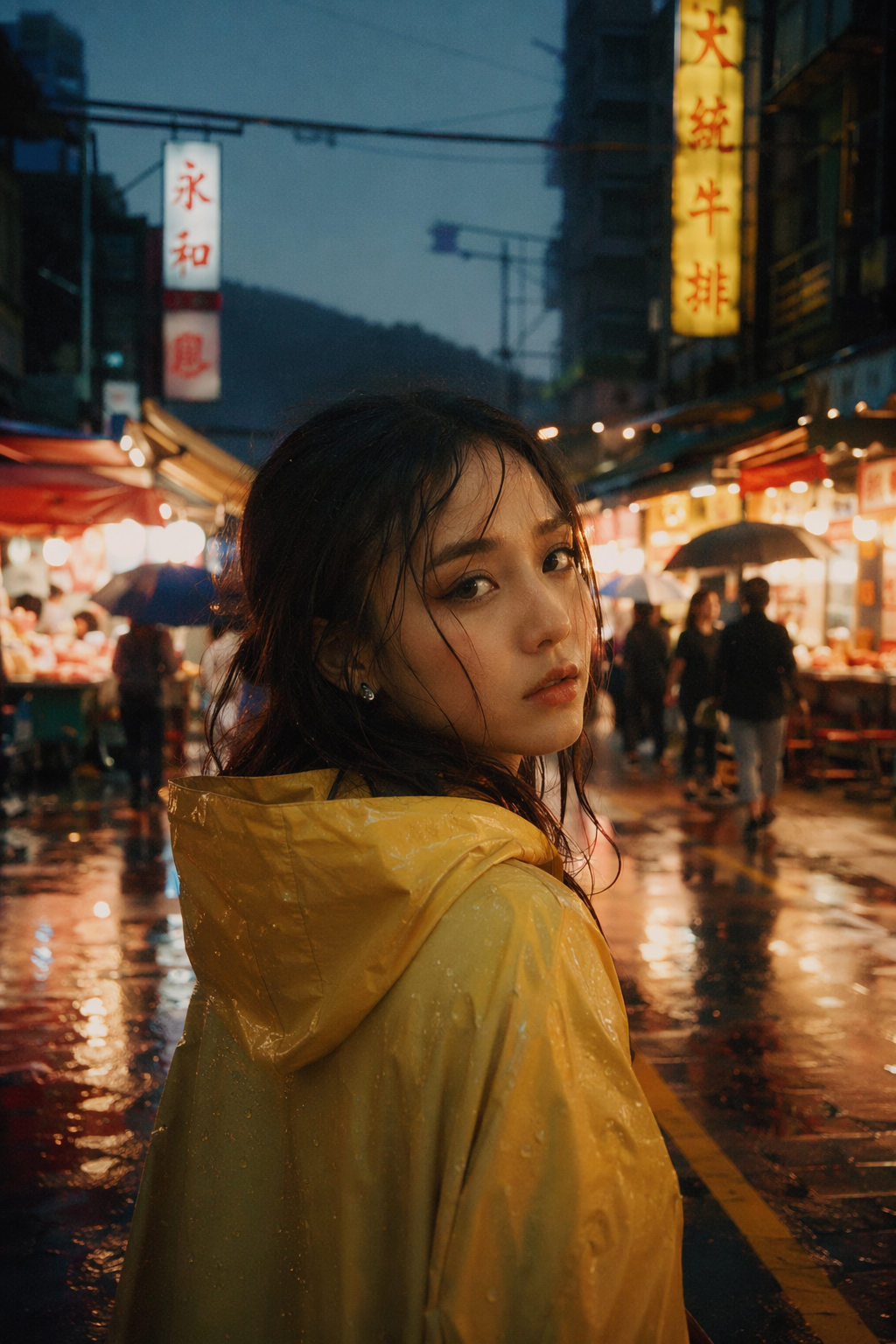
Prompt: "Bring this portrait to life: she blinks naturally, wind gently moves her hair, neon reflections shimmer on the wet street, subtle cinematic push-in"
Grok Imagine 1.5 justified its existence in one take: the face stays unmistakably her across an 8-second clip — 2–3 seconds longer than everyone else — with a natural blink and a slow push-in. At 80 credits for 720p, this is the cheapest believable photo animation we have seen.
Seedance held identity well but re-framed the shot tighter than the source, effectively cropping the composition. Great face, less of your original picture.
Kling preserved both the face and the widest view of the original scene, with the crispest output of the four. If the source image composition matters, Kling treated it with the most respect.
Hailuo delivered a dreamy slow blink and kept the likeness, though it drifts softer and moodier than the source grade.
Takeaway: identity preservation is a solved problem in this class — all four faces stayed recognizably the same person. Choose by budget (Grok), fidelity to source framing (Kling), or atmosphere (Hailuo).
What Each Video Actually Costs
Credits below are per single clip on CreateVision at the settings we tested (budget tier = lowest resolution offered, standard = what we used above). No subscriptions were harmed: all 16 test videos in this article cost less than a single stock-footage clip license.
| Model | Budget tier | Standard tier | Notes |
|---|---|---|---|
| Grok Imagine 1.5 | 40 credits (480p) | 80 credits (720p) | Image-to-video only; 8s clips — lowest cost per second here |
| Hailuo 02 | 40 credits (512p / 6s) | 120 credits (768p / 6s) | 1080p / 10s options push it to 240 |
| Seedance 2.0 Mini | 75 credits (480p) | 150 credits (720p) | T2V and I2V priced the same |
| Kling 3.0 Turbo | — | 275 credits (720p), 350 (1080p) | No true budget tier; you pay for the finish |
For scale: a free CreateVision account starts with enough credits to run several Grok or Hailuo budget clips; the full 16-video test in this article consumed roughly 2,150 credits worth of generation.
Which One Should You Pick?
Four models, four different answers depending on what you are actually making:
Pick Grok Imagine 1.5 if you animate photos
Old family photos, product stills, portrait posts — anything that starts from an image. At 40–80 credits per 8-second clip it is 2–5× cheaper than the alternatives, and Round 5 shows the quality holds. Just remember: no starting image, no video.
Pick Hailuo 02 if you need one cheap model that does everything
It was never the sharpest in any round, but it was never disqualified either: T2V and I2V, coherent physics, real mood in the lighting, from 40 credits. Skip it only when your clip needs fine detail or on-screen text.
Pick Kling 3.0 Turbo when the clip has to look real
It won or tied the realism call in every round it entered, rendered the only legible text of the test, and — surprise — posted the fastest average generation time (~108s measured). Budget accordingly: one Kling clip costs about seven Grok clips.
Pick Seedance 2.0 Mini for directed, cinematic shots
The best continuous camera control of the test and color that comes out looking graded. For social-first storytelling where you describe the shot like a director, it delivers the brief most faithfully at a mid price.
Frequently Asked Questions
Why is Grok Imagine 1.5 missing from the text-to-video rounds?
Because its API literally will not accept a job without a starting image — image input is a required parameter, which we confirmed first-hand while building this test. It is a pure image-to-video model, which is also why it can afford to be the cheapest option here.
Were these results cherry-picked from multiple takes?
No. Every video embedded in this article is the first and only generation for that model-prompt pair — including the failures. That is also why Hailuo's illegible latte art is on the page.
Which model is fastest?
In our measured runs Kling 3.0 Turbo averaged ~108 seconds per clip — the fastest of the four despite being the most expensive. Grok single-take came in at ~78 seconds. Seedance Mini and Hailuo both averaged around 3 minutes. Treat all of these as same-day weather, not physics: queue load moves them.
Can I run the same test myself?
Yes — all four models run from one CreateVision account, which is exactly how this test was performed (that is the point of a multi-model workspace: no four subscriptions, no four top-ups). Pick a prompt, run it through each model, and your comparison will be more relevant to your use case than anyone else's benchmark.